
Use Cases
Different Communities
One Platform.
Each customer builds their own Streamliner community, connecting suppliers, carriers, warehouses, and retailers on a single collaborative platform.
Every community solves their unique challenges using the same technology.
The use cases below demonstrate how collaboration, visibility and automation drive measurable results and eliminate friction.
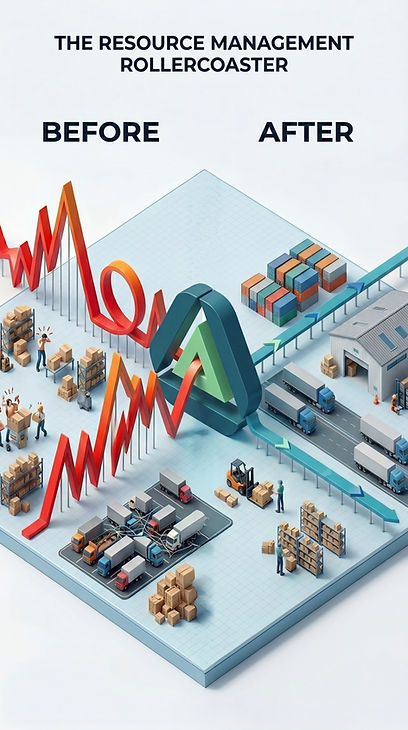
Use Case 1: Taming the Resource Management "Rollercoaster"
The Challenge: A manufacturing company's warehouse reception team was trapped on a daily operational rollercoaster. They frequently experienced long periods of complete inactivity, suddenly followed by an overwhelming influx of trucks. This imbalance made it impossible to plan staffing effectively, leading to excessive overtime costs during the rushes and wasted labor expenses during the lulls.
The Streamliner Solution: The manufacturer deployed Streamliner to take control of their inbound flow. Because appointments in Streamliner start directly from the order, the system knows exactly what cargo is arriving. Streamliner's optimization engine uses this data to dynamically allocate capacity based on the real-time availability of warehouse staff, specific zones (e.g., deep freeze vs. ambient), and equipment (like forklift availability).
The Result: The optimization engine actively levels the workload throughout the day. The warehouse manager now has a clear, real-time view of expected shipments and can plan resources accordingly. By smoothing out the operations, the manufacturer can now run their reception with a smaller, more stable team, drastically reducing overtime and significantly boosting overall productivity.
Use Case 2: Eliminating Yard Congestion and Bottlenecks
The Challenge: A regional transport company was hesitant to use digital booking tools because previous systems provided "estimated" windows that were rarely honored. Drivers often arrived for their scheduled 09:00 slot only to find a queue of unscheduled trucks, or they were forced into "standard" 30-minute blocks that didn't allow enough time for their actual load size, leading to stressful delays and incomplete deliveries.
The Streamliner Solution: The warehouse implemented Streamliner’s Order-Centric Scheduling, which calculates the exact time required based on the actual pallets and volume in the carrier's specific shipment. This data is synchronized with the site’s real-time labor capacity, and the system integrates directly with existing gate kiosks. Upon arrival, the driver enters their unique PIN at the kiosk, which recognizes their specific order and immediately directs them to the correct gate.
The Result: Carriers now have 100% confidence that their 09:00 appointment means they will be at the dock at 09:00 for the exact duration their cargo requires. By removing the "guessing game" of waiting times and ensuring realistic processing windows, the warehouse reached a +98% carrier adoption rate within months, as partners now view the platform as a tool that protects their own driver's schedule and productivity.


Use Case 3: Eliminating Fragmented Communication and Dispute Delays
The Challenge: A large wholesaler was drowning in administrative overhead. Whenever a delivery arrived with discrepancies—such as damaged goods, partial shipments, or missing paperwork—it triggered an endless, confusing chain of emails and phone calls between the warehouse team, the purchasing department, the supplier, and the carrier. This fragmented communication led to delayed problem resolution, frustrating disputes over liability, and unpaid invoices, all while lacking a clear audit trail.
The Streamliner Solution: The distributor implemented Streamliner to act as their central supply chain collaboration hub, creating a "Social" network for their logistics. Because every shipment is directly linked to the original order, communication is entirely centralized around the PO number. If goods arrive damaged, the warehouse reception staff takes a photo and uploads it directly to the shipment record. Using the platform's standardized issue management and smart chat function, they instantly notify the exact supplier and carrier involved, without needing to look up contact details.
The Result: Disputes are now handled on the spot with unambiguous documentation and a complete audit trail. The administrative time previously wasted on "order chasing" has plummeted. Furthermore, because each stakeholder manages their own users, the distributor’s contact database (CRM) is always up to date, even when partner staff change or go on holiday. Partners now review their Service Level Agreements (SLAs) using objective, real-time dashboards where they can see their specific performance details and compare them anonymously with the broader community average.
Use Case 4: The "Ocean-to-Dock" Link (D&D Intelligent Arbitration)
The Challenge: A global importer had real-time tracking (RTTVP data) but still faced high D&D fees because the warehouse used Excel as tool and couldn't prioritize containers fast enough based on financial risk. The massive amount of data resulted in an Excel of 150 columns, which was hard to maintain and error prone. As a result the priorities were not already managed correctly resulting in out of stock and high unpredictable D&D charges.
The Streamliner Solution: By integrating Real-Time Visibility Platform (RTTVP) data into Streamliner, the company applied Intelligent Arbitration. The system identifies containers closest to their "Last Free Day" and balances this financial risk against commercial urgency (e.g., backordered stock).
The Result: The company stopped processing containers blindly. For large operations, this automation contributes to a reduction in total D&D fees of more than 50% by closing the execution loop between the port and the dock.
